
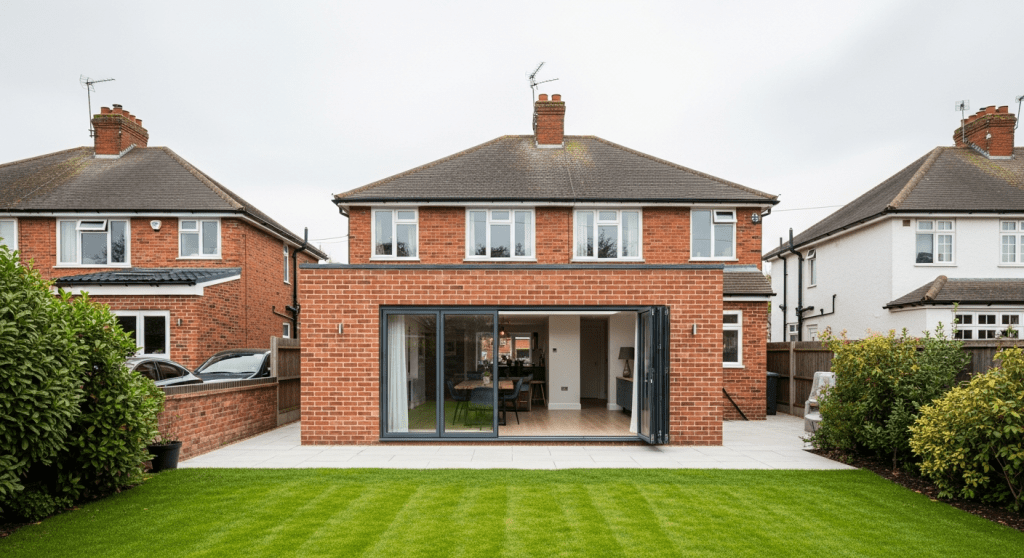
If you’re planning a house extension, loft conversion, or outbuilding that falls within permitted development rights, you might think there’s no need to involve the council at all. After all, permitted development means you don’t need planning permission — so why bother with any paperwork?
The answer is a Lawful Development Certificate (LDC). While it isn’t legally required, obtaining one before you start building is one of the smartest decisions you can make as a homeowner. It provides formal, written confirmation from your local planning authority that your proposed work is lawful — and it can save you from significant problems down the line.
What Is a Lawful Development Certificate?
A Lawful Development Certificate is a legal document issued by your local planning authority confirming that a proposed development is lawful under current planning legislation. For extensions and alterations that fall within permitted development rights, you would apply for a Certificate of Lawfulness of Proposed Use or Development (sometimes called a CLOPUD or simply a proposed LDC).
The certificate confirms that, based on the information and plans submitted, the council is satisfied that your project complies with the permitted development rules set out in the Town and Country Planning (General Permitted Development) (England) Order 2015 (as amended). Once granted, the certificate is a permanent legal record that can be relied upon by you, future buyers, solicitors, and mortgage lenders.
Why You Should Get an LDC Before You Build
1. Legal Protection
Permitted development rules are detailed and contain numerous conditions, limitations, and measurements that must be met precisely. If your extension exceeds even one of these limits — for example, the maximum height, depth, or distance from a boundary — it is not permitted development, and you will have built without planning permission. This is a planning breach, and the local authority has the power to serve an enforcement notice requiring you to alter or demolish the work.
An LDC confirms in advance that the council agrees your proposal is compliant. If the certificate is granted, the council cannot later take enforcement action against the development as described in your application.
2. Protection When Selling Your Property
When you come to sell your home, the buyer’s solicitor will carry out property searches and ask for evidence that any building work was done lawfully. If you’ve built an extension without planning permission and without an LDC, the solicitor may raise it as a problem. This can delay or even collapse a sale.
An LDC provides clear, indisputable proof that your extension was lawful at the time it was built. It removes uncertainty and gives buyers confidence that there are no planning issues with the property.
3. Mortgage and Insurance Requirements
Mortgage lenders and building insurers may ask for evidence that extensions and alterations were carried out lawfully. Without an LDC or planning permission, you may find it harder to remortgage your property or obtain building insurance for the extended area. Some lenders will require an indemnity insurance policy to cover the risk — an unnecessary cost that an LDC would have avoided entirely.
4. Avoiding Neighbour Disputes
Even if your extension is within permitted development limits, neighbours may question whether the work is lawful — particularly if it affects their light, views, or privacy. If a neighbour complains to the council and you don’t have an LDC, the planning authority may investigate and ask you to demonstrate compliance. This can cause delays, stress, and professional fees that could have been avoided.
With an LDC already in place, you have official confirmation from the council. It puts any dispute to rest quickly and protects your position.
5. Building Regulations Are Separate
It’s important to understand that an LDC only addresses the planning question — it confirms the work doesn’t need planning permission. Building regulations approval is a separate legal requirement and will still be needed for most extensions, loft conversions, and structural alterations. Building regulations cover the technical construction standards such as structural integrity, fire safety, insulation, drainage, and ventilation. You should ensure you have both an LDC (for planning) and building regulations sign-off (for construction standards).
How Architectural Plans Help You Obtain an LDC
When you apply for a Lawful Development Certificate, you need to submit detailed plans and drawings that clearly demonstrate your proposal complies with the permitted development rules. The local authority will assess your application based on the information you provide — so the quality and accuracy of your drawings is critical.
Professional architectural drawings produced by a qualified Architectural Technician will include:
- Accurate existing and proposed floor plans showing the full extent of the works
- Existing and proposed elevations showing heights, materials, and relationship to boundaries
- A site plan showing the position of the extension relative to the property boundaries and any neighbouring buildings
- Cross sections where needed to demonstrate compliance with height restrictions
- Clear annotations showing all relevant measurements — depths, heights, distances from boundaries, and roof ridge levels
- Details of materials to demonstrate they are similar in appearance to the existing dwelling
Poorly drawn or incomplete plans are one of the most common reasons LDC applications are refused or delayed. The council needs to see clearly that every permitted development condition has been met. Professional CAD drawings make this straightforward and give the planning officer everything they need to approve the certificate without unnecessary queries.
What the LDC Application Process Involves
Application and Timescales
An LDC application is submitted to your local planning authority, typically through the Planning Portal. The current application fee for a proposed LDC for a householder development is half the cost of a full planning application. The council has 8 weeks to determine the application, though in practice many are decided sooner if the drawings are clear and the proposal is straightforward.
What You Need to Submit
A completed application form (available on the Planning Portal)
A site location plan at 1:1250 or 1:2500 scale with the site edged in red
Existing and proposed floor plans, elevations, and sections
A written statement explaining how the proposal complies with the relevant PD rules
The application fee
Quick Recap: Permitted Development Limits for Extensions
Single-Storey Rear Extensions
Up to 3m from the rear wall (attached houses)
Up to 4m from the rear wall (detached houses)
Up to 6m/8m under Prior Approval (Larger Home Extension scheme)
Maximum eaves height of 3m
Must not exceed the height of the highest part of the existing roof
Two-Storey Rear Extensions
Maximum depth of 3m from the original rear wall
Must be at least 7m from the rear boundary
Matching materials required
Roof pitch must match the existing house
Side Extensions
Single storey only
Maximum width of half the original house
Maximum eaves height of 4m
Must not be on a side elevation fronting a highway
When PD Rights Don’t Apply
Remember that permitted development rights can be removed or restricted in certain circumstances. If your property is in a Conservation Area, is a listed building, or has had PD rights removed by a condition on the original planning permission or an Article 4 Direction, you will need to apply for full planning permission instead. Flats and maisonettes do not benefit from householder PD rights. If you are unsure whether your property has full PD rights, we can check for you.
How companies like BHD Limited Can Help
At BHD Limited, we produce professional architectural drawings that are specifically designed to support LDC applications. Our plans clearly demonstrate compliance with all relevant permitted development conditions, giving the planning officer everything they need to approve your certificate quickly and without unnecessary delays.
Whether you use our remote survey service through Blueprint by BHD or arrange an in-person survey at your property, you’ll receive detailed CAD drawings — floor plans, elevations, sections, and a site plan — all suitable for submission to your local authority as part of an LDC application.
If you’re planning an extension and want to make sure everything is done properly from the start, get in touch. We’ll assess your proposal, confirm whether it falls within permitted development, and produce the drawings you need.
Email: info@bhd-limited.co.uk
Wolverhampton: 01902 283154 | Telford: 01952 948250

 Nick Garvey MCIOB - Chartered Construction Manager
Leave a comment